The international AI Management System Standard
ISO/IEC 42001 Compliance,
End to End
Everything you need to know about the international AI Management System Standard: what it covers, why it matters now, how to get certified, and how Modulos accelerates the process.
What is ISO/IEC 42001?
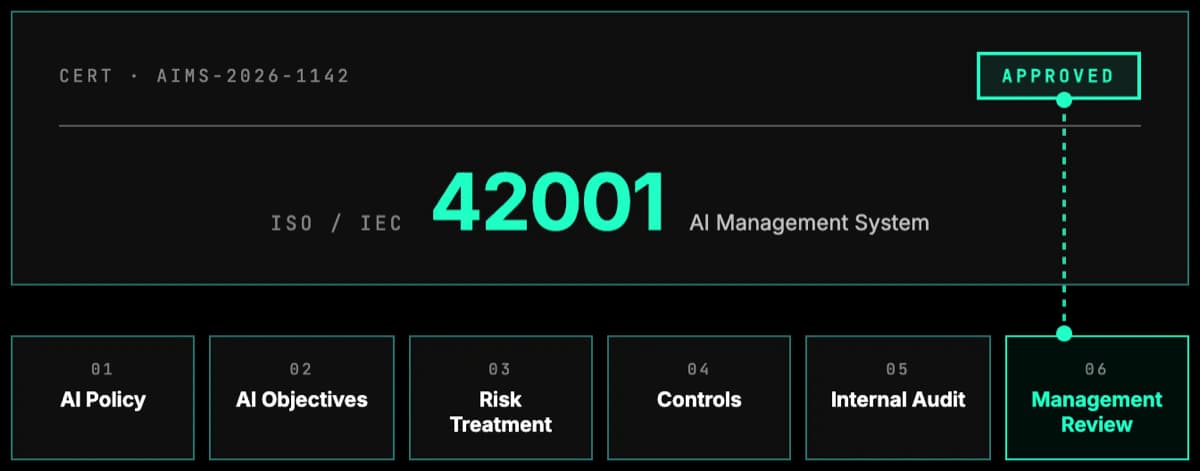
ISO/IEC 42001:2023 is the first international management system standard for artificial intelligence, published in December 2023 by ISO/IEC JTC 1/SC 42. It specifies how an organisation should govern its AI systems across their entire lifecycle, from strategy to operation.
The standard introduces the term AI Management System (AIMS): a set of policies, processes, roles, and controls that an organisation operates to develop, deploy, and use AI responsibly. It applies to any organisation regardless of industry, size, or whether it builds AI or buys it.
ISO 42001 is not a checklist of “AI controls” to tick off. It is a management system standard in the same family as ISO 9001 (quality), ISO 14001 (environment), and ISO 27001 (information security). It expects an organisation to define a scope, set policies, identify and treat risks, operate controls, monitor performance, and continually improve. Annex A's controls are the reference set you start from, not the standard itself.
For depth, read the Modulos ISO/IEC 42001 implementation guide.

International Standard
ISO/IEC 42001:2023
AI Management System
Published
December 2023
First edition, status 60.60 (International Standard published)
Edition
1
Pages
51
Stage
60.60
ICS
35.020
Technical Committee
ISO/IEC JTC 1/SC 42
Artificial intelligence
Why ISO/IEC 42001 matters now
Three forces are pushing AI management systems from optional to expected.
Regulatory pull
Governance backbone for AI-system regulation
ISO/IEC 42001 sits at the organisation level, the EU AI Act and similar regimes at the AI-system level. 42001 will not be adopted as a harmonised standard under the AI Act and does not give a presumption of conformity. It does provide the governance scaffolding any system-level regime expects an organisation to operate: defined scope, risk treatment, lifecycle controls, monitoring, management review. Holders of 42001 reach AI Act readiness, the US NIST AI RMF, and other AI-specific regimes faster, because the management system that all of these assume is already in place.
Procurement pull
Boards and enterprise buyers are starting to require it
Enterprise buyers in regulated industries are increasingly making ISO/IEC 42001 a procurement gate for their AI suppliers. Boards are asking for it. RFPs are starting to list it. The certification is becoming a checkmark in the supplier-due-diligence pack, especially for AI vendors selling into financial services, healthcare, and the public sector.
Operational pull
Even Swiss regulators point to ISO 42001 for safety-critical AI
The Canton of Zurich Innovation Sandbox for AI report (2025) on autonomous inspection robots concludes that ISO/IEC 42001 offers the practical structure for connecting EU AI Act and EU Machinery Regulation requirements in a single AI management system. When regulators in safety-critical industries point at the standard as the operational framework, that is a strong signal that 42001 has moved past the early-adopter window. Read the Sandbox report (PDF, zh.ch).
What is in the standard: clauses, annexes, and roles
ISO/IEC 42001 follows the harmonised ISO management-system structure, which means holders of ISO 9001 or ISO 27001 will recognise the shape immediately.
Clauses 4–10
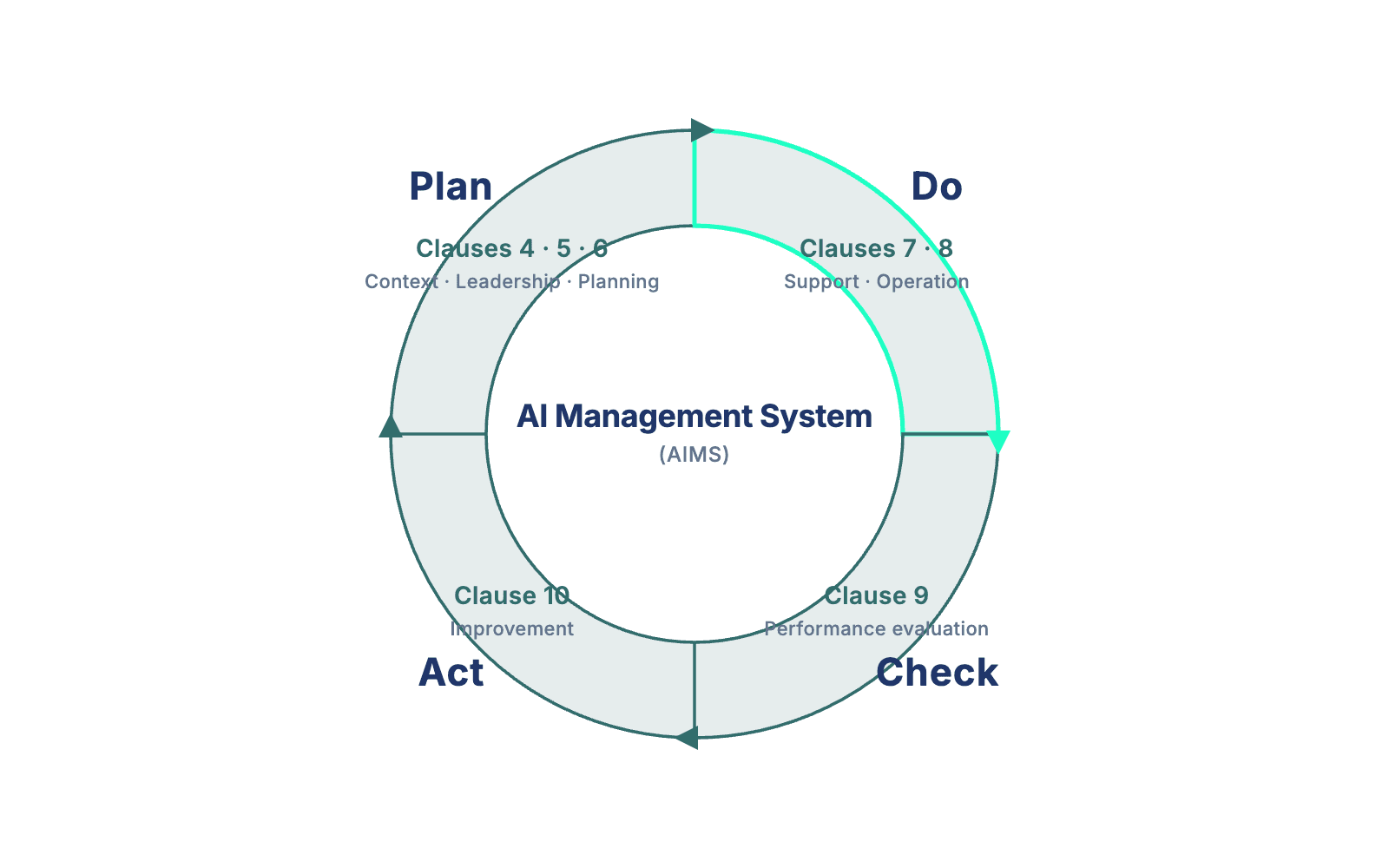
Read as a Plan-Do-Check-Act cycle: plan (4–6), do (7–8), check (9), act (10).
- 4
Clause 4: Context
Define the AIMS scope, the internal and external context the organisation operates in, and the interested parties whose needs and expectations the system must address.
- 5
Clause 5: Leadership
Top management commitment, the AI policy, and the assignment of roles and responsibilities for AI governance.
- 6
Clause 6: Planning
AI risk assessment and treatment, AI system impact assessment, and the AI objectives that flow from them.
- 7
Clause 7: Support
Resources, competence, awareness, communication, and documented information.
- 8
Clause 8: Operation
Operational planning and control, and the controls themselves.
- 9
Clause 9: Performance evaluation
Monitoring, measurement, internal audit, and management review.
- 10
Clause 10: Improvement
Nonconformity, corrective action, and continual improvement.
For a full clause-by-clause implementation guide, read the Modulos docs.
Annexes A–D
Critical to get right, because most explainer pages get this wrong. A and B are normative (you must address them). C and D are informative (helpful but not required).
Reference control objectives and controls
The starting set of controls every AIMS is expected to address. Not the standard itself: this is where you start, not where you stop.
Implementation guidance for Annex A
How the Annex A controls look in practice. Read alongside Annex A, not separately.
Potential AI-related organisational objectives and risk sources
An idea bank to help you tailor your risk register and objectives. Helpful, not required.
Using the AIMS across domains and sectors
Guidance on applying the management system in different industries and use cases. Helpful, not required.
For the Modulos guide to using the annexes without falling into checklist theatre, read the docs.
Roles, responsibilities, and competence
ISO 42001 sets hard requirements for leadership, the AI policy, role definition, and competence. It does not enumerate specific role names; the organisation defines those.
What the standard requires
Hard requirements drawn directly from clauses 5 and 7. Apply to every AIMS.
- Clause 5.1
Top management commitment
Top management demonstrates leadership and commitment to the AIMS, sets direction, authorises resources, and owns outcomes.
- Clause 5.2
An AI policy
Top management establishes an AI policy that frames objectives, accountability for the AIMS, and a commitment to continual improvement.
- Clause 5.3
Defined responsibilities and authorities
Top management assigns and communicates responsibilities and authorities for roles relevant to the AIMS. The standard requires that roles be defined; it does not enumerate specific role names.
- Clauses 7.2 & 7.3
Competence and awareness
Personnel whose work affects the AIMS must be competent (training, education, experience) and aware of the AI policy, their contribution to it, and the implications of not conforming.
Roles organisations typically define
The standard requires roles to be defined and leaves the specifics to the organisation. These are the roles teams most often stand up when implementing 42001. Pick what fits your scope and document it.
- Suggested
AI policy / AIMS owner
Operationalises the AI policy day-to-day. Coordinates clauses 4–10 across the organisation. Usually a senior governance, risk, or compliance role.
- Suggested
AI risk owners
Accountable for specific AI risks within their scope. Sign off on risk treatment and acceptance.
- Suggested
AI system owners
Accountable for specific AI systems and the controls applied across their lifecycle.
Trusted by 200+ organizations
Modulos customers include aDigital, SCSK, ETH, PwC, Berner Fachhochschule, Mobile Health, Serai, CertX, JobCloud, Xayn, Beyond Gravity, Armasuisse.


How ISO/IEC 42001 relates to other frameworks
Most organisations operate ISO 42001 alongside other standards rather than instead of them. Here is where 42001 sits relative to the frameworks teams most often ask about.
| Standard | Domain | Relation to ISO/IEC 42001 |
|---|---|---|
| ISO/IEC 27001 | Information security | Complementary |
| SOC 2 | US service-organisation attestation | Co-exists |
| EU AI Act | Binding EU regulation | Different layer |
| EU Machinery Regulation | Safety-critical machinery in the EU | Operational glue |
| NIST AI RMF | US voluntary framework | Complementary |
ISO/IEC 42001 vs ISO/IEC 27001
ComplementaryISO/IEC 27001 covers information security; ISO/IEC 42001 covers AI management. They share the harmonised ISO management-system structure (clauses 4–10), so organisations already operating 27001 can re-use document control, internal audit, management review, and corrective action processes. AI-specific governance (AI risk assessment, AI system impact assessment, lifecycle controls) sits on top. See how to integrate them.
ISO/IEC 42001 vs SOC 2
Co-existsSOC 2 is a US attestation against the AICPA Trust Services Criteria for service organisations. ISO/IEC 42001 is an international management system standard for AI. They target different audiences (US enterprise customers vs international markets) and different scopes (general security and availability vs AI specifically). Many organisations carry both.
ISO/IEC 42001 vs EU AI Act
Different layerISO/IEC 42001 and the EU AI Act sit at different levels and should not be conflated. ISO 42001 is an organisation-level AI Management System; the AI Act regulates specific AI systems, with separate obligations on providers and deployers of high-risk systems. ISO 42001 is not being adopted as a harmonised standard under the Act and will not appear in an Annex ZA, so 42001 certification does not provide a presumption of conformity. It remains valuable as the governance backbone around your AI portfolio, just not as a substitute for the Act's system-level technical and conformity-assessment requirements. Read more on the EU AI Act page.
ISO/IEC 42001 vs EU Machinery Regulation
Operational glueFor AI in safety-critical machinery, ISO/IEC 42001 helps structure the governance and documentation that the Machinery Regulation conformity assessment requires. The Canton of Zurich Innovation Sandbox for AI report shows how a single integrated AIMS can address both regimes simultaneously rather than running parallel processes. See the Sandbox report (PDF).
ISO/IEC 42001 vs NIST AI RMF
ComplementaryNIST AI RMF is a voluntary US framework focused on AI risk practices; ISO/IEC 42001 is a certifiable international management system. Many organisations use NIST AI RMF as a risk-practice library and 42001 as the certifiable wrapper around it. See the NIST AI RMF page.
Comparing platforms? See how 20 AI governance platforms support ISO/IEC 42001 in our 2026 enterprise buyer’s guide.
The certification process
Four steps from kickoff to certificate. Typical timeline is 6 to 12 months. Most of it is not the audit.
Gap analysis
Map current governance and AI practices against the standard. Identify what is already in place, what is missing, and what needs to be reworked. The output is a remediation plan and a rough timeline.
Implementation and evidence collection
Define scope, write or update policies, set up risk assessment and treatment, run the controls, and produce the records that prove all of this is happening. This is where the bulk of time goes, typically 60 to 80 percent of the total effort. This is where software earns its keep, because evidence collection is the bottleneck.
Internal audit and management review
ISO management systems require both before the external audit. The internal audit checks conformance against the standard. Management review confirms leadership accountability and resource allocation.
External audit (Stage 1 and Stage 2)
Stage 1 is a documentation review: the auditor checks that the AIMS is in place and ready. Stage 2 is the implementation audit: the auditor verifies the AIMS is actually being run as documented. After a successful Stage 2, the certification body issues the certificate. Annual surveillance audits follow.
The common failure mode
Treating certification as a documentation sprint rather than a governance program. Cramming policies for the audit produces a certificate that decays the moment policies change. The point is durable governance, and audits are won on records: decisions, approvals, dated evidence, traceability. That is what surveillance audits check between certifications.
Choosing a certification body
ISO/IEC 42001 certificates are issued by independent accredited certification bodies. The choice of auditor is yours, driven by scope, geography, and any existing certification relationships you already maintain.
Modulos is auditor-agnostic: the platform manages your AIMS records regardless of which accredited body you select. Verify accreditation through your national accreditation body or the International Accreditation Forum (IAF) directory.
Cost is typically a mix of audit fees (paid to the certifying body, scope-dependent), implementation effort (internal time and tooling), and ongoing surveillance audit fees each year.
Common implementation challenges
The standard is well-written. The challenge is making the AIMS actually run. Five problems every team meets, and what tends to work.
Securing leadership commitment
ISO 42001 requires top-management accountability. Without a named executive sponsor with budget authority, the AIMS becomes shelfware that nobody owns and nobody updates.
Practical advice: Tie the program to a concrete commercial outcome: an RFP requirement, a customer ask, EU AI Act exposure on a product line. Sponsorship follows business pressure.
Cross-functional collaboration
AI governance cuts across compliance, data science, product, security, and legal. The biggest failure mode is treating it as a compliance-only project, which produces policies that the engineering teams never read.
Practical advice: Stand up a cross-functional working group with named owners per clause. Make AI risk owners and AI system owners accountable, not optional.
Evidence collection at scale
The volume of records (risk assessments, impact assessments, model documentation, training data lineage, monitoring logs) exceeds what spreadsheets and SharePoint can carry. This is where most timelines slip.
Practical advice: Make records appear as a byproduct of the work, not as a separate documentation effort. Connect tools to the AIMS rather than re-typing logs into a tracker.
Model drift and continuous compliance
AI systems change. Models retrain, data pipelines shift, behaviour drifts. ISO 42001 is not a one-shot certification: surveillance audits check that the AIMS is actually being run between audits.
Practical advice: Build monitoring into the AIMS from day one. Bias, drift, and performance checks belong in the management system, not in a post-audit tab.
Integration with existing management systems
Most enterprise buyers already operate ISO 27001 or SOC 2. Running ISO 42001 in parallel with separate document control, internal audit, and management-review cycles doubles the work and halves the consistency.
Practical advice: Share document control, internal audit, management review, and corrective action with existing systems. Keep AI-specific governance (AI risk, AI impact assessment, lifecycle controls) explicit and separable, but not parallel.
How Modulos accelerates ISO/IEC 42001 certification
The bulk of an ISO 42001 certification is evidence collection, control mapping, and management-review records. Modulos automates the parts software is good at so the governance team can focus on decisions.
Multi-framework governance graph
ISO/IEC 42001 controls map to EU AI Act articles, NIST AI RMF functions, and other frameworks simultaneously. One control can satisfy requirements from multiple regulations: collect evidence once, reuse across frameworks.
Risk quantification in monetary terms
ISO 42001 requires AI risk assessment and treatment. Most platforms offer qualitative scales. Modulos quantifies AI risk in monetary terms across the portfolio, which is what boards and regulators increasingly expect.
AI agents that do the work
Scout drafts control assessments and identifies gaps; the Evidence Agent collects evidence from connected sources; the Control Assessment Agent runs continuous validation. Records exist as a byproduct of work, not as a separate documentation effort.
Continuous testing
Connect AI systems and data sources; schedule automated tests for bias, drift, and performance. Monitoring is built into the AIMS rather than bolted on for the audit.
Audit-ready exports
Generate structured compliance reports, evidence packs, and audit trails that satisfy regulator and auditor requirements. The Stage 1 documentation review and Stage 2 implementation audit have a single source of truth.
For a clause-by-clause walkthrough of how Modulos operationalises ISO/IEC 42001, see the Modulos docs.
Why Modulos for ISO/IEC 42001
Three independently dated, externally verifiable facts no other AI governance vendor can replicate.

The first AI governance platform certified against ISO/IEC 42001
CertX, an accredited Swiss certification body, issued certificate 213-001/24 to Modulos on 12 July 2024. This is the first certificate ever issued under the CertX-AI V1.0 scheme, granted seven months after ISO/IEC 42001 was published.
It is a product conformity certificate. CertX has independently confirmed that the Modulos platform itself meets ISO/IEC 42001:2023 requirements as a tool for operating an AI management system. That is a higher bar than an organisation certifying its own AIMS, and no other AI governance platform has achieved it.
Read the press release →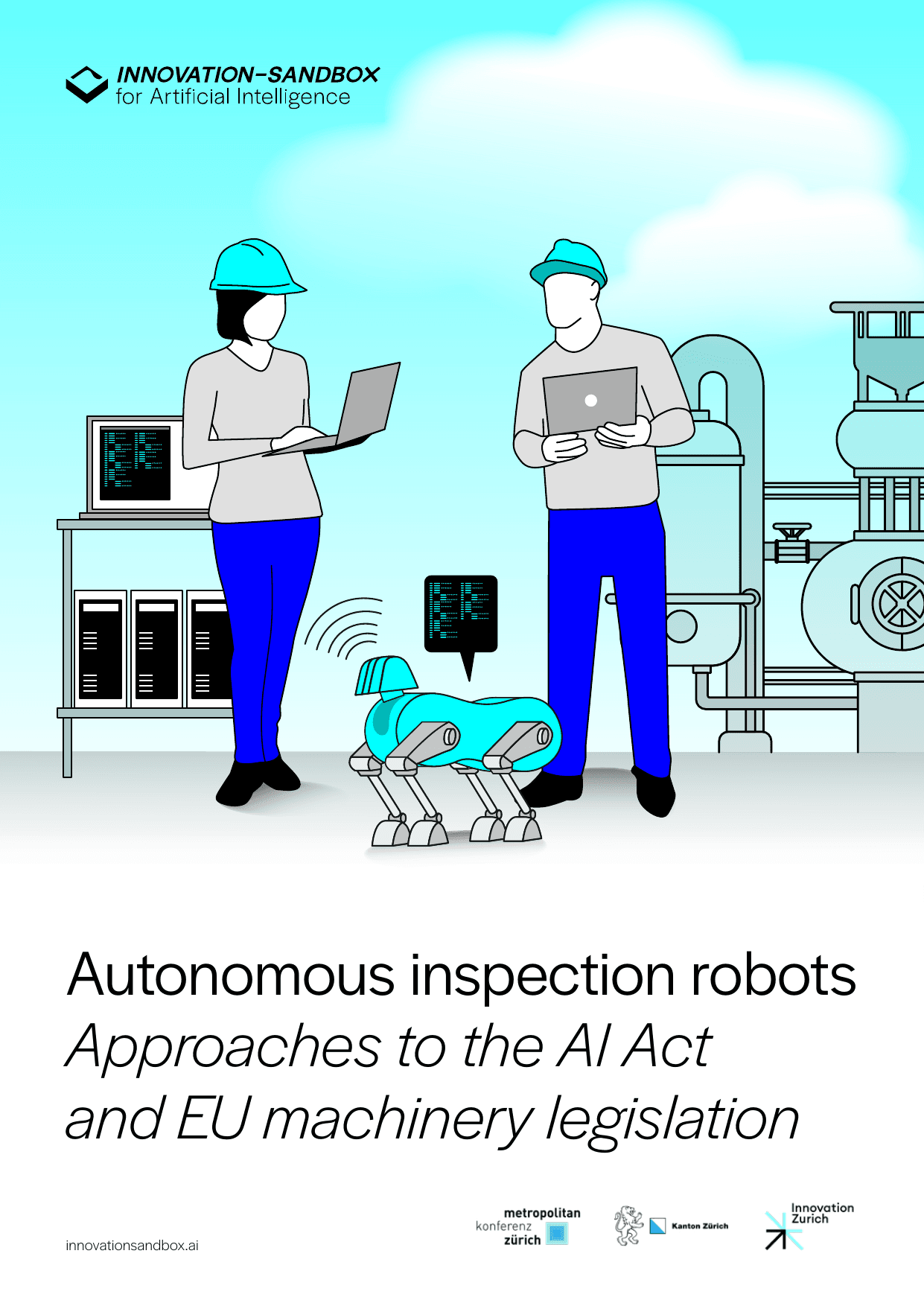
The reference implementation chosen by Swiss regulators
The Canton of Zurich's Office for Economic Development and the University of Zurich's Centre for Information Technology, Society, and Law (ITSL) published the Autonomous Inspection Robots Innovation Sandbox report in 2025, addressing how AI products in critical infrastructure can comply with the EU AI Act and EU Machinery Regulation in parallel.
Section 3.3 of the report, AI governance and ISO/IEC 42001, documents Modulos as the AI governance platform used to implement an ISO/IEC 42001-aligned AIMS for the use case (ANYbotics' ANYmal robot). Government and academia pointing to Modulos as the reference implementation, independent of any commercial relationship.
Read the Sandbox report (PDF, zh.ch) →
Xayn: first ISO/IEC 42001 certification in Germany, in four weeks
Xayn (developer of Noxtua, Europe's first sovereign Legal AI) achieved ISO/IEC 42001 certification audited by SGS, becoming the first German company to do so. Time to audit-readiness: four weeks. Time reduction versus a manual approach: 50%.
“Modulos AI Governance Platform streamlined our process. Without it, we would have spent twice the amount of time manually creating control lists from ISO 42001 annexes and linking subpages. What stood out with Modulos was the intuitive, guided approach. The platform's built-in guidance made the process seamless, and the ability to easily re-share and follow controls in the order provided was very efficient.”
FAQ about ISO/IEC 42001
ISO/IEC 42001:2023 is the first international management system standard for artificial intelligence, published in December 2023 by ISO/IEC JTC 1/SC 42. It specifies how an organisation should govern its AI systems across the entire lifecycle. It applies to any organisation that develops, deploys, or uses AI, regardless of industry or size.
Further reading
Deeper dives from the Modulos team on ISO/IEC 42001 implementation, integration with ISO 27001, and what it takes to get certified fast.
ISO 42001 explained: requirements, certification and implementation
ISO 42001 in plain English. What the standard requires, the certification process and timeline, and how to implement it as evidence, not a checklist.
Read more →
ISO 27001 vs ISO 42001: how to run them as one integrated management system
AI governance is becoming a key pillar in the development and deployment of AI systems. It helps organizations mitigate a wide range of risks, including legal, operational, and ethical ones, and avoid...
Read more →
Fast-tracking ISO 42001 Certification for Xayn
Discover how Xayn fast-tracks ISO 42001 certification for Noxtua, Europe's pioneering Legal AI, enhancing governance in the legal industry with cutting-edge technology.
Read more →Ready to certify your AI Management System?
Talk to the team behind CertX product conformity certificate 213-001/24, the Canton of Zurich Innovation Sandbox reference implementation, and Xayn's 4-week ISO/IEC 42001 certification.