AI Compliance in the
Middle East: What You
Need to Know
From the UAE PDPL to Saudi Arabia's SDAIA Ethics Principles, new AI frameworks are taking shape across the Gulf. Modulos helps you stay compliant: faster, easier, and in line with ISO 42001.
Why AI Regulations in the Middle East Matter
Governments across the GCC are investing heavily in artificial intelligence and pairing that investment with stricter oversight. Today, 15% of public cloud spending in the region goes toward AI, and regulators are responding with new laws on data privacy, ethics, and accountability.
Compliance isn't optional. Violations can lead to serious consequences:
Fines of up to SAR 5 million (Saudi Arabia) or AED 5 million (UAE)
Disqualification from public tenders
Delays in financing or product launches
Staying ahead of local laws while aligning with global AI standards like ISO 42001, is now critical for any AI-driven organization operating in the region.
AI Regulations Across the Gulf
Each Gulf country is advancing its own approach to AI governance. While timelines and enforcement vary, most combine legally binding data protection laws with ethical AI frameworks and procurement requirements.
| Country | AI Laws (Hard Law) | Soft Law & Guidelines | Enforcement Highlights |
|---|---|---|---|
| UAE | PDPL 45/2021 (in force); DIFC Regulation 10 (finance); Draft AI Law expected 2025 | AI Ethics Charter (2024); Ethical AI Toolkit (2018) | Data Office audits; public tender exclusions |
| Saudi Arabia | PDPL (in force since Sep 2023); Draft AI Law expected 2026 | SDAIA Ethics Principles (2023); Generative AI Guidelines (2024) | SDAIA accreditation required; PDPL fines up to SAR 5M |
| Qatar | Personal Data Privacy Law 13/2016; Draft national AI policy (2024) | QCB FinTech sandbox guidelines | Regulator approval needed for cross-border transfers |
| Bahrain | PDPL 30/2018; CBB notice on AI use in Open Banking (2023) | EDB AI Ethics Pledge | Central Bank sandboxes and ongoing supervisory review |
| Oman & Kuwait | Data protection decrees; national AI strategies under development | Ethics toolkits forthcoming | Enforcement mechanisms to be confirmed |
Shared AI Governance Trends in the Gulf
Despite different regulatory timelines, several key principles are consistent across Gulf countries:
Privacy by design
Most data protection laws in the region are modeled on GDPR, requiring clear consent, transparency, and data minimization.
Ethics in public procurement
In the UAE, Saudi Arabia, and Bahrain, ethical AI practices are increasingly tied to supplier eligibility. Ethics self-assessments are often required for tender participation.
Compliance benchmark
Agencies like Emirates Health Services and Saudi Arabia's SDAIA are early adopters of ISO 42001. Certification is emerging as a trusted signal of organizational readiness for AI oversight.
AI Risk Categories in the Gulf
Understanding risk levels helps organizations prioritize compliance efforts based on the potential impact of their AI systems.
High-Risk AI
Systems used in healthcare, justice, public safety, or critical infrastructure.
These typically require:
- Human oversight and override mechanisms
- Bias detection and mitigation
- Ongoing performance monitoring
Medium-Risk AI
Includes systems for credit scoring, hiring, insurance, and personalized recommendations.
These typically require:
- Transparency for users
- Periodic audits
- Documented risk assessments
Low-Risk AI
Covers tools like spam filters or internal chat assistants. While regulatory obligations are minimal, general compliance with PDPL and ethics principles still applies.
Your AI Compliance Roadmap for the Middle East
Modulos helps organizations meet regional requirements faster by guiding you through a clear, five-step compliance path tailored to Gulf regulations.
Map Your AI Portfolio
Document all AI systems and use cases. Tag each one against obligations from the UAE PDPL, Saudi PDPL, SDAIA Principles, and local AI charters.
Build an AI Management System (AIMS)
Use ISO 42001 as the foundation for governance. Extend your existing ISO 27001 or risk frameworks to include the full AI lifecycle.
Complete Required Ethics Assessments
Prepare and submit forms like the MOAI AI Seal (UAE) and SDAIA Self-Assessment (Saudi Arabia) for high-risk use cases, often required before tenders or go-lives.
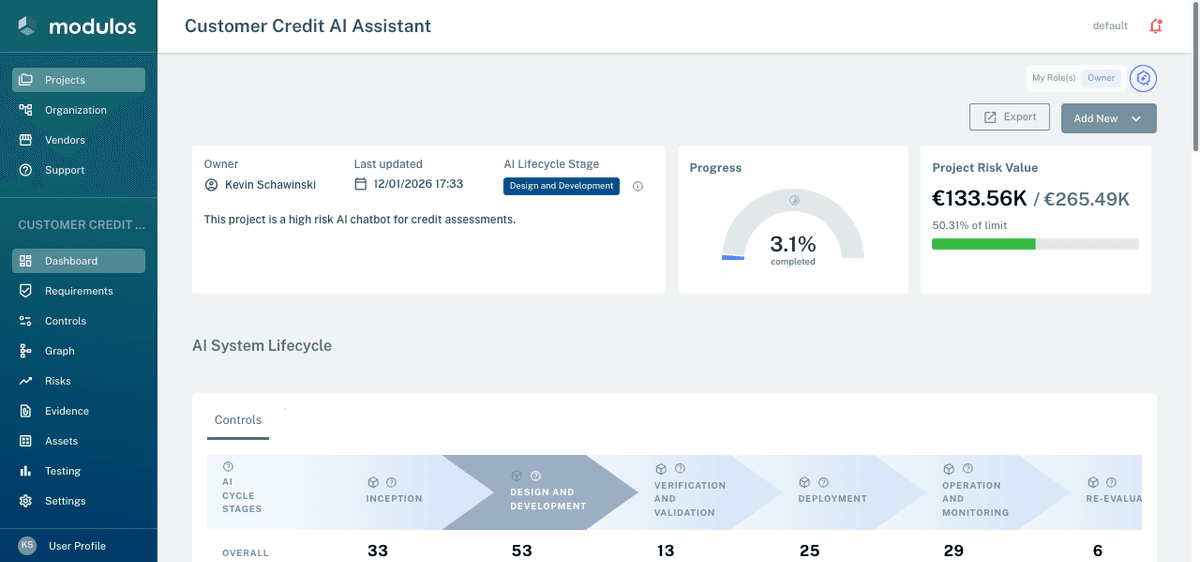
Establish Ongoing Monitoring
Set up dashboards to track model drift, bias metrics, and data quality over time. Continuous monitoring is increasingly expected by Gulf regulators.
Prepare for Audits and Certifications
Generate audit-ready documentation and evidence packages. ISO 42001 certification can differentiate your organization in competitive tenders.
Trusted by 200+ organizations







FAQ about Middle East AI Regulations
Not yet, but it's becoming a key signal of organizational readiness. Entities like SDAIA and Emirates Health Services already use ISO 42001 as their governance baseline, and regulators are likely to follow their lead.
Yes, in many cases. If you're bidding on government contracts or working in regulated sectors like healthcare or finance, ethics self-assessments are often mandatory. Even for private-sector use, they demonstrate due diligence.
It can. If your AI system processes data from EU residents or your services are offered to EU customers, the EU AI Act may apply regardless of where your infrastructure is located. Many Gulf organizations are aligning with both regional and EU requirements.
PDPL (Personal Data Protection Law) focuses on data privacy and handling, similar to GDPR. AI-specific laws and guidelines (like SDAIA Ethics Principles) address broader concerns like algorithmic fairness, transparency, and human oversight. Both may apply to your AI systems.
Partially. ISO 27001 provides a strong foundation for information security, but AI compliance requires additional considerations like bias monitoring, model explainability, and AI-specific risk assessments. ISO 42001 extends these concepts specifically for AI management.
High-risk typically includes AI used in healthcare decisions, criminal justice, critical infrastructure, or systems that significantly impact individuals' rights. Check the specific guidelines from UAE's AI Office, SDAIA, or relevant sectoral regulators.
Start documenting your AI systems and their risk levels now. Regulators often look favorably on organizations that demonstrate good-faith efforts toward compliance. Modulos can help you build a structured compliance roadmap while regulations continue to evolve.
Ready to Simplify AI Compliance in the Gulf?
Modulos gives you the structure, automation, and documentation tools to meet AI regulations across the Middle East, with less overhead and more confidence. Book a demo to see how Modulos helps you stay ahead of PDPL, SDAIA, ISO 42001, and more.